
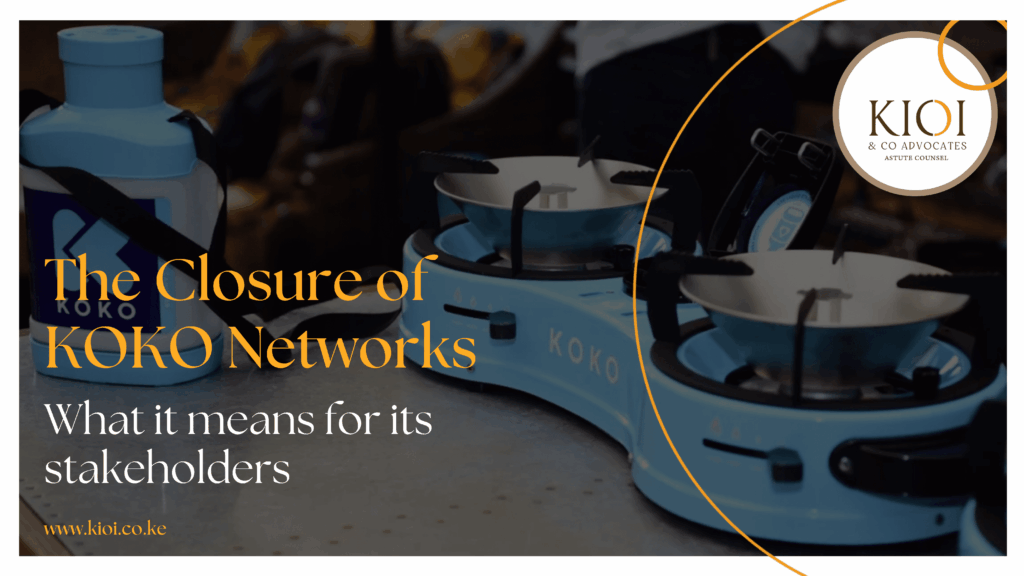
The Closure of KOKO Networks and what it means for its stakeholders
On 1 February 2026, KOKO Networks (“KOKO” or the “Company”), one of Kenya’s most high-profile green energy companies, plunged into administration, with PwC’s Muniu Thoithi and George Weru appointed as joint administrators to try to put together a rescue package for the Company.
KOKO was founded as far back as 2013 and had become a leading provider of clean bioethanol-based cooking fuel to over 1.3m low-income families in Kenya. It had raised over USD 100m in debt and equity from a diverse investor base including Microsoft Climate Innovation Fund and Rand Merchant Bank.
In a normal insolvency, these investors would be looking at writing down a huge loss. However, one unique element of the KOKO story is that in March 2025 the Company took out a USD 179.6m political risks insurance guarantee, with the Multilateral Investment Guarantee Agency (“MIGA”), a division of the World Bank (the “MIGA Guarantee”). The rationale behind taking out the MIGA Guarantee was likely the fact that KOKO had enjoyed somewhat strained relations with the Government of Kenya (“GoK”) in recent years. For example, in 2023, the Company was rocked by a GoK decision to block the importation of bioethanol, forcing it to rely solely on more expensively produced (and more sporadically available) sources within Kenya. There had also been a history of fluctuating government subsidies for bioethanol, which impacted the company’s forecasting ability.
KOKO and its investors are alleging that the reason for their collapse was a breach of contract by GoK in refusing to issue a letter of authorisation, which would have allowed the Company to sell carbon credits (generated by measuring the environmental harm reduction which came from families switching to bioethanol fuel from kerosene or charcoal) into international markets. The company was also apparently seeking a licence to import cheaper (and more stably priced) bioethanol fuel made from sugar molasses, which would have reduced the subsidies they needed to provide to make their product competitive with charcoal and kerosene.
The arguments advanced by GoK against issuing such a letter appear to boil down to two principal objections essentially. Firstly, a scepticism regarding the actual environmental impact of the switch to bioethanol vs the claims the Company was making. Secondly, the Government of Kenya contended that if KOKO had been able to sell the volume of carbon credits it was requesting, that would essentially have taken up all of Kenya’s capacity (in accordance with the Paris Agreement) to issue carbon credits, which could otherwise be spread across a variety of sectors, including the vital agriculture and manufacturing industries.
It looks likely, given the overtly political nature of the circumstances surrounding the Company’s collapse, that the investors in KOKO will seek to make a claim under the MIGA Guarantee. Whilst the MIGA Guarantee is not a publicly available document, according to MIGA, the policy “covers the risks of expropriation, war and civil disturbance, transfer restriction, and breach of contract for up to 15 years”. It therefore seems likely that the requirement for MIGA to make a payment will turn on whether or not GoK breached a contract with KOKO. This will involve a detailed analysis of the MIGA Guarantee itself, and the content of any agreements and interactions between GoK and KOKO.
In the event that payment is made under the MIGA Guarantee, it is likely that MIGA would take action against GoK through the courts under the legal principle of subrogation of claims. This could obviously be a long and drawn-out process, but one which the Kenyan legal community will doubtless be following closely.
At Kioi & Co. our experienced insolvency team understands the complexities of distressed situations, and can provide practical, tailored advice to help steer a business through difficult times. The key to avoiding a disastrous insolvency which destroys stakeholder value is taking legal advice at the earliest possible stage. Please do not hesitate to reach out to us.