
In today’s evolving business environment, many Kenyan companies turn to consultants for flexibility and specialized expertise. However, calling someone a “consultant” does not automatically make them one in the eyes of the law. If the working relationship looks like employment, the law may treat it as employment, regardless of the title in the contract. For businesses, getting this classification right is crucial to avoid back taxes, statutory liabilities, and employment claims.
KEY DISTINCTIONS
The table below outlines the distinctions between employees and consultants, highlighting the legal implications that arise from each classification:
| Employees | Consultants | |
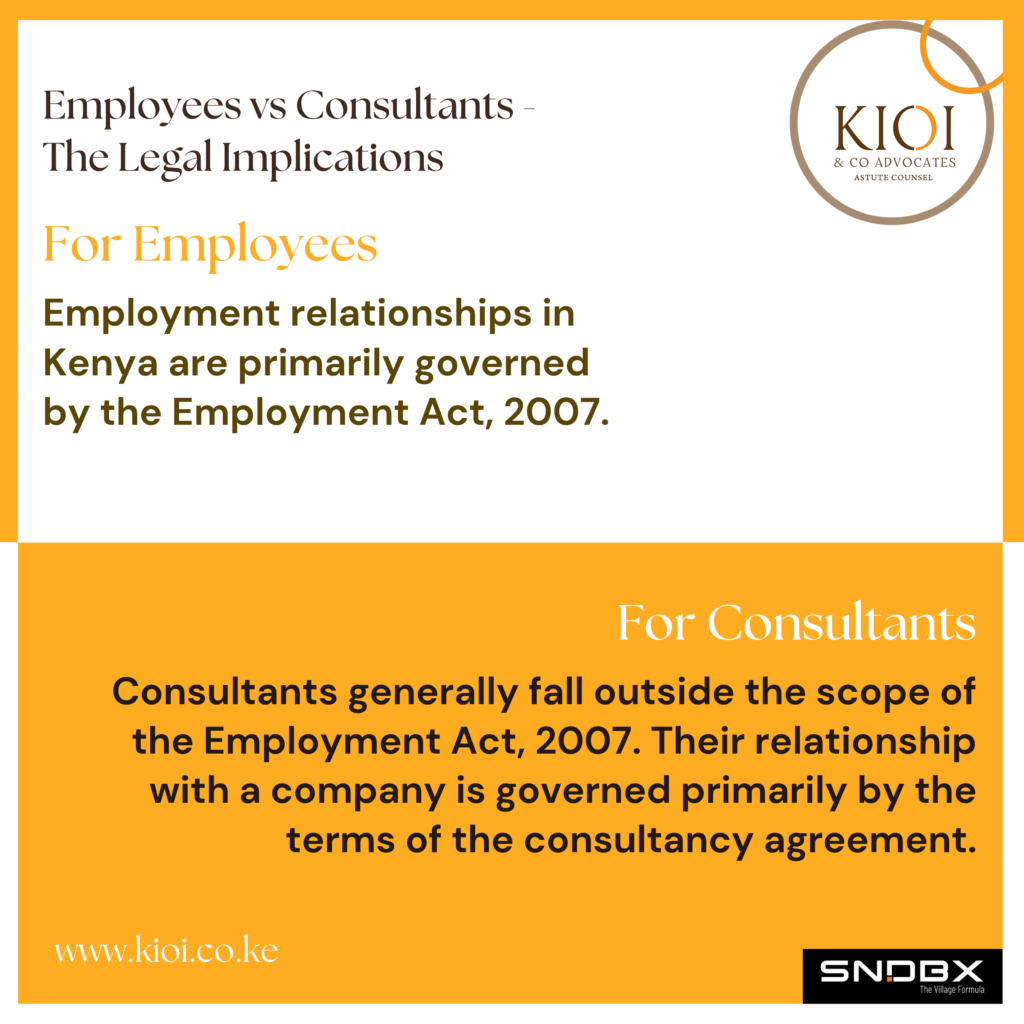
| Legal framework | Employment relationships in Kenya are primarily governed by the Employment Act, 2007. | Consultants generally fall outside the scope of the Employment Act, 2007. Their relationship with a company is governed primarily by the terms of the consultancy agreement. |
| Contract type | An employee is engaged under a contract of service to render a range of agreed services based on their experience and capabilities. | An consultant is engaged as a contract for service to perform a specific scope of work or project for an agreed fee. |
| Employment law protections and rights | Employees are entitled to statutory protections under the Employment Act, 2007 (e.g. paid annual leave, sick leave, maternity/paternity leave). | Consultants are not entitled to employment protections. They only receive the rights specifically stated in their consultancy agreement. |
| Tax obligations | Employers are obligated to deduct PAYE tax and remit statutory deductions on behalf of employees (e.g. SHIF). | Consultants typically pay their own taxes. They invoice for the services rendered and may be subject to withholding tax. |
| Control and direction | Employees typically operate under a high degree of employer control, with the employer directing their work, setting fixed working hours, providing the tools or resources required, and integrating them into the organization’s structure. | Consultants work independently, decide how and when to perform the work, and often work for multiple clients. |
| Liability | Employers bear vicarious liability for acts done by an employee done in the course of employment. | Consultants are usually responsible for their own professional liability and may be required to carry professional indemnity insurance. |
Here at Kioi & Co. Advocates, we understand that it is important for employers to understand the distinction between an employee and a consultant, how each relationship should be managed, and the need for well-drafted agreements to minimize potential liabilities.
Our experienced team is available to guide you through every step to provide you with peace of mind and legal security. Please feel free to contact us at info@kioi.co.ke or book a consultation with any of our Associates for this or any other related legal matters.